
UK Climate Nature Crisis: What the National Emergency Briefing Revealed
At the end of November, Central Hall Westminster became the setting for one of the most direct and unified messages ever delivered about the climate and nature crisis facing the United Kingdom. The National Emergency Briefing brought together leading scientists, security specialists, economists, health experts and environmental researchers. More than one thousand invited guests filled the hall, including policymakers, journalists, business leaders and representatives from civil society.
The message was not softened or vague. It was clear, urgent and grounded in evidence. And now, thanks to the popular science channel Just Have a Think, the key information has been presented to the public in a concise and accessible video.
The story that unfolded at Westminster
The briefing opened with Professor Kevin Anderson. His words set the tone for the entire event. He explained that the United Kingdom now stands at a critical point. He described the stark choice ahead:
“We can pursue deep, rapid and fair decarbonisation of modern society, which will require major but organised changes. Or we can continue with delay and empty rhetoric while temperatures continue to rise.”
This was not framed as a political preference but as a factual assessment of the scientific evidence.
The next part of the briefing focused on national security. Lieutenant General Richard Nugee drew attention to the way climate change is already destabilising communities around the world. He warned that environmental pressures are now operating as a “threat multiplier” that intensifies geopolitical risk, food shortages, migration and instability.
Health experts followed. Professor Hugh Montgomery described how rising temperatures, worsening air quality and extreme weather are already affecting human health across the United Kingdom. He made it clear that healthcare systems are increasingly stretched by climate related emergencies.
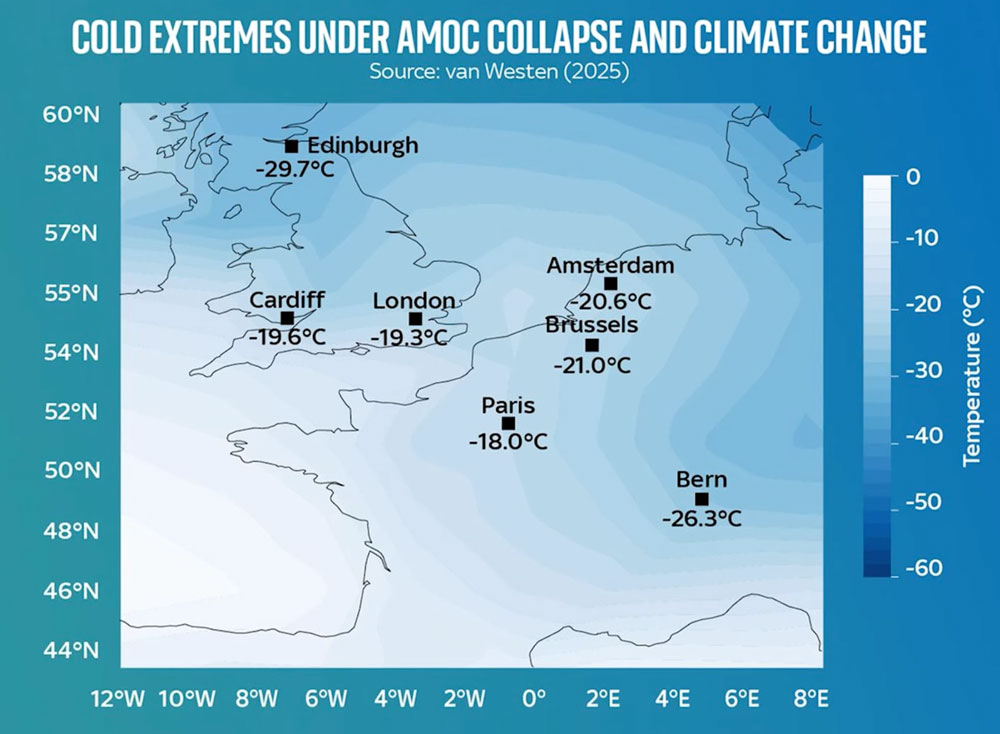
Professor Tim Lenton: If the AMOC crosses a tipping point, the UK and northern Europe could face a level of cooling that would overwhelm our ability to grow many of the crops we rely on.
Finally, Professor Tim Lenton explained how natural systems are approaching tipping points. These tipping points are thresholds where change becomes irreversible and self reinforcing. The message was simple. Preventing tipping points is far cheaper and far safer than trying to adapt after they are crossed.
Together, these speakers built a narrative that was impossible to ignore. Climate change is not a future concern and not an abstract threat. It is a present reality that affects security, health, food, infrastructure, nature and the economy.
Why this matters in Northamptonshire
The evidence presented at the briefing aligns with what councils, schools, health services and community groups in Northamptonshire are already observing. Local flooding, heatwaves, damage to infrastructure and rising energy pressures are not isolated events. They are part of a wider national pattern described by the experts in Westminster.
For organisations involved in carbon literacy, including Northants Carbon Literacy, the briefing reinforces the importance of education. When communities understand the scale of the challenge, they are more empowered to take meaningful action, influence policy and build resilience.
What can I do?: Write to the Prime Minister and Senior Media Leaders
One clear conclusion from the National Emergency Briefing is that the United Kingdom needs leadership that treats climate and ecological breakdown as a national emergency. The scientific evidence is not disputed by the experts. What is missing is full political commitment and consistent media coverage.
Public pressure matters. It influences political decisions and media priorities. Every letter helps strengthen the call for honest communication and urgent climate action.
To send your letter CLICK HERE - It just takes a few seconds.


Northants Carbon Literacy is committed to spreading awareness and knowledge about carbon reduction strategies. Our goal is to empower communities and individuals to make sustainable choices for a better future.
Pages
Contact us
Sense House
Hogarth Drive
Barton Seagrave
NN15 5UQ
01536 234388
Electoral Commission Imprint: Promoted by D.Dell on behalf of Northamptonshire Green Party c/o 38 Waverley Rd, Kettering, NN15 6NT